
For emergency department clinicians
Decision support for the emergency department,
from first contact to admission.
Your hospital's pathways on web and mobile, rapid medication histories for the ED pharmacist, and a pathway record that hands over to triage and the admitting team.
Available on iOS and Android. Pathways are enabled by your health service. Book a demonstration for your service.
The challenges
- Emergency clinicians make rapid decisions across every specialty, often overnight, while local guidance sits in documents that are slow to search.
- Medication histories are taken under time pressure, and an incomplete history follows the patient to the ward.
- The department works from a bed map, with no view of which beds hold the patients at highest medication risk.
- Assessments made by paramedics or in the emergency department are repeated by the triage or admitting team.
From presentation to plan
Your hospital's pathways for any presentation, reaching a patient-specific plan in under a minute on average.
1. Search the presentation
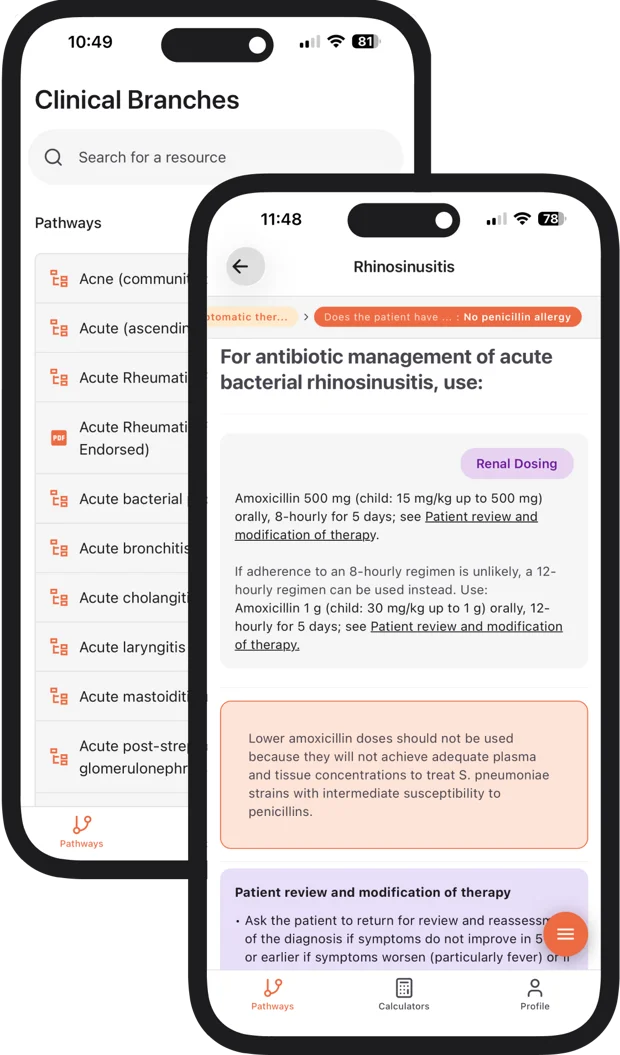
Search by presentation and open your hospital's pathway on the web or mobile app, online or offline.
2. Answer the key clinical questions
Severity, allergies, renal function and the other patient factors your guideline depends on, with a specific option at each branch.
3. Receive a plan
A patient-specific recommendation with dosing calculators integrated, and clear endpoints for referral, escalation or admission.
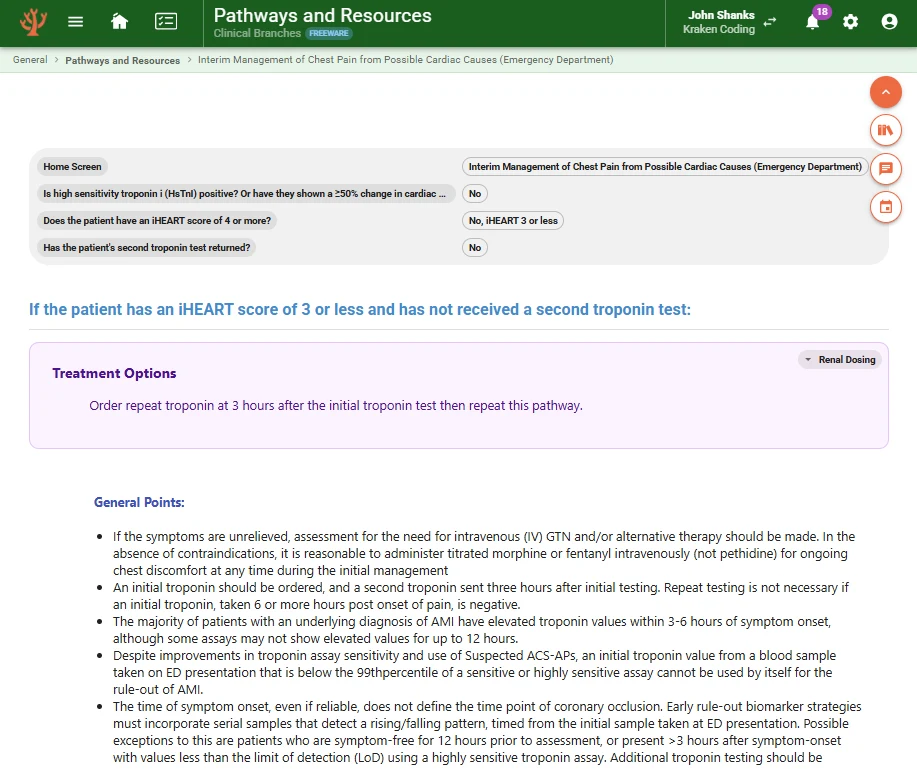
- 48.1 seconds on average to complete a pathway
- Offline access on iOS and Android
- Your hospital's guidance, versioned and kept current
- Decisions recorded automatically
Support across the department
01 · ED PHARMACIST
Rapid medication histories to support assessment
The ED pharmacist dictates the medication interview or photographs the patient's medicines on the mobile app, giving the treating team an accurate history while the assessment is still underway. The same history carries to the ward as the start of the medication management plan.
- Dictation or medication photos at the bedside
- History available to the treating team straight away
- Carried to the ward pharmacist, without retyping
02 · BED MAP
Medication risk shown by bed location
Patients are risk scored by location, so the department sees which beds hold the patients at highest medication risk on the bed map it already works from, rather than in a separate list.
- Risk shown by bed, cubicle and fast-track location
- The hints your service enables drive the score
- The ED pharmacist goes to the highest-risk beds first
03 · HANDOVER
The pathway record becomes the handover
Clinical Branches can be used before the patient is admitted. The pathway completion record goes directly to the admitting team as handover, and where ambulance services use the platform, the pathway completed by paramedics goes directly to the triage team.
- Pathway route, answers, guidance version, clinician and time in one record
- Used before admission, in the ambulance or the emergency department
- No repeat assessment at triage or on admission
What emergency clinicians say
At nighttime when you are dealing with a deteriorating patient, being able to get onto [Clinical Branches] and figure out how to broaden cover to cover sepsis with unknown origin or something is extremely, extremely helpful.
John and his team have been great to work with. They're incredibly responsive and easy to deal with, bringing changes online rapidly. They're fantastic to work with on customisations specific to our clinical needs.
48.1s
average time to complete a pathway
28 to 68%
optimal prescribing at the WACHS Emergency Telehealth Service, local audit
20.8 pts
improvement in prescribing appropriateness where adopted, in the WACHS and UTS evaluation
iOS
and Android apps with offline access
The WACHS Emergency Telehealth Service figure is a local audit across three NAPS-defined audit periods. Joint evaluation of the platform by the WA Country Health Service (WACHS) and the University of Technology Sydney (UTS), funded by the Digital Health Cooperative Research Centre (DHCRC-0248). Prescribing was compared before and after implementation in a balanced sample of three adopter and five non-adopter hospitals, and the estimates describe an effect observed where the platform was adopted. WACHS deploys the platform as AMPS. Read the evaluation snapshot (PDF).
Download the app
Download Clinical Branches and sign in with your health service account. Your pharmacy department can enable your hospital's pathways.
Is your hospital not yet using Clinical Branches? Contact our team.
Explore other roles