
For anticoagulation stewards
Safer anticoagulation
and VTE prevention.
Monitor VTE risk assessment, identify anticoagulant safety risks and audit prophylaxis continuously.
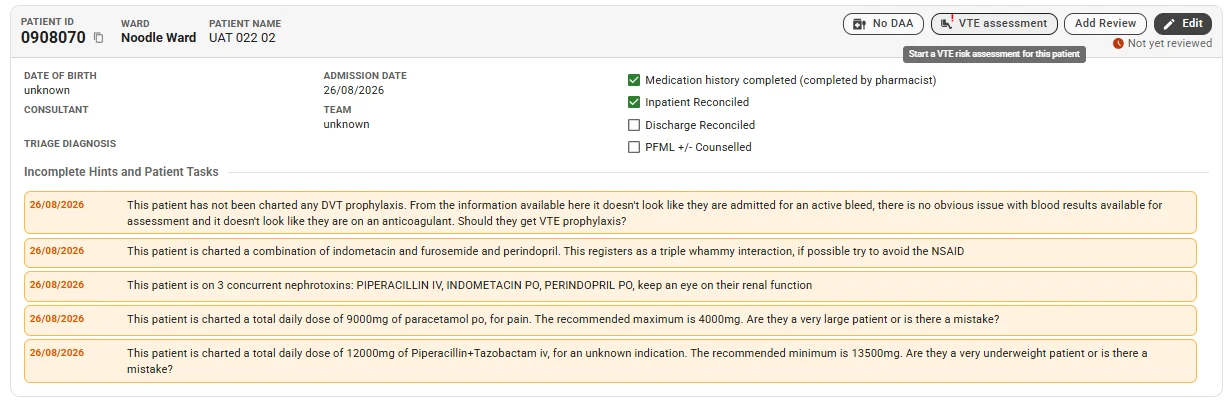
Each assessment ranks the stewardship list and reveals variation in VTE prevention.
The challenges
- Anticoagulants are among the highest-risk medicines in hospital, reported against NSQHS Action 4.15 and the VTE Prevention Clinical Care Standard, and stewardship teams must choose between reviewing only treatment-dose anticoagulation and reviewing every patient's VTE risk and prophylaxis.Anticoagulants are among the highest-risk medicines in hospital, and stewardship teams must choose between reviewing only treatment-dose anticoagulation and reviewing every patient's VTE risk and prophylaxis.
- Stewardship works both ways. A patient missing prophylaxis matters as much as one who is over-anticoagulated, and finding both builds trust with the treating teams.
- Telling appropriate from inappropriate prophylaxis and dosing needs a reliable system, which is difficult to build from written notes or inconsistent EMR data, and risk assessment is rarely connected to the prophylaxis prescribed.
- Education fixes a recurring issue, only for the next rotation of staff to repeat the same error.
- A busy team may rightly withhold VTE prophylaxis after trauma or surgery, but without a system monitoring the patient, prophylaxis is often not restarted once they have stabilised.
- Without laborious audits, there is no way to see which wards or teams contribute to missed or inappropriate prophylaxis.
Capabilities for anticoagulation stewardship
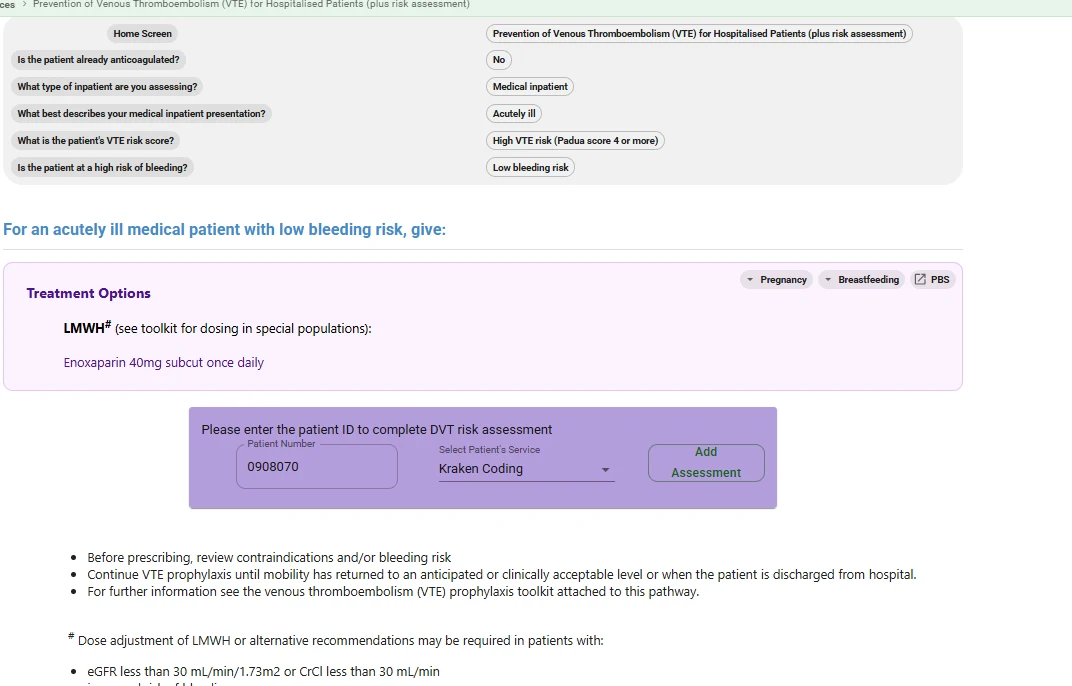
VTE risk assessment, thromboprophylaxis and treatment pathways, built from your procedures.
01 · VTE RISK ASSESSMENT
VTE risk assessment dashboard
Report the proportion of patients assessed within 24 hours and reassessed within 7 days, Padua and Caprini risk bands, and average time to assessment, with prophylaxis reported by agent and mechanical method.
- Hint when no chemical prophylaxis is charted and no contraindication is recorded
- Hint to restart prophylaxis when the reason for withholding has resolved
- VTE risk assessment integrated into the pharmacist admission workflow
02 · DOSING AND DUPLICATION
Identify dosing errors and therapeutic duplication
Anticoagulant hints screen every patient, selected by your service from a shared library of thousands, and bedside ratings refine each hint over time. Your senior pharmacists can build their own rules on the hint builder canvas or adopt rules from other services. Examples from the library include:
- Treatment-dose enoxaparin checked against renal function
- Oral anticoagulant charted alongside heparin or enoxaparin
- Apixaban or dabigatran with interacting medicines, and warfarin with interacting antibiotics
- Antiplatelet with anticoagulant, and standard renal dose checks
03 · AUDIT AND EVIDENCE
Integrated anticoagulant audit
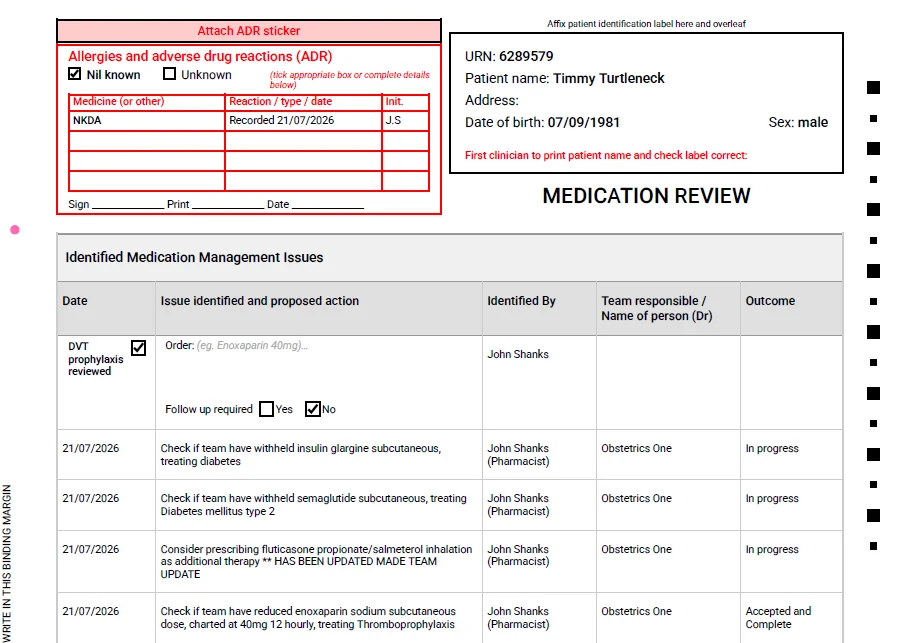
Continuous audit with anticoagulant categories: optimal, sub-optimal, unconventional, inappropriate and no prophylaxis. Results support Action 4.15 and the VTE clinical care standard.Results are reported alongside the rest of your stewardship program. Prophylaxis decisions are recorded on the medication review for governance and audit.
- Assessment timeliness, prophylaxis and audit results by ward
- Variation identified to target education and deeper review
04 · TREATMENT PATHWAYS
Anticoagulation treatment pathways
Cardiovascular and anticoagulation pathways, including DOAC-associated bleeding, guide prescribers at the point of care, and your service can build its own from local procedures. Anticoagulation stewards from participating services review each pathway through the shared review panel before publication.
20.8 pts
improvement in antimicrobial prescribing appropriateness, using the same pathway and hint model
84%
of 2,214 hints rated useful by pharmacists over 12 months, local evaluation
48.1s
average time to complete a pathway
77
hospitals live across Australia and Canada
The evaluation result was measured for antimicrobials, not anticoagulants. Joint evaluation of the platform by the WA Country Health Service (WACHS) and the University of Technology Sydney (UTS), funded by the Digital Health Cooperative Research Centre (DHCRC-0248). Prescribing was compared before and after implementation in a balanced sample of three adopter and five non-adopter hospitals, and the estimates describe an effect observed where the platform was adopted. WACHS deploys the platform as AMPS. Read the evaluation snapshot (PDF). The hint figure comes from a 12-month virtual stewardship programme at Far West Local Health District that reviewed every patient on an antimicrobial, presented at the SHPA Medicines Management conference. It is a local audit, not an independent evaluation. RAPA, named in the poster, is the audit tool within Clinical Branches. Read the conference poster (PDF).
Implementation and support
A managed service with implementation, upgrades and support included.
Browser-based deployment
Runs in the browser on managed devices, with native iOS and Android apps. Single sign-on with Microsoft Entra ID is in production at multiple health services.
Live in two to six months
Environment, configuration and single sign-on in four to eight weeks, local content review alongside, then onboarding in two to four weeks per site group.
Upgrades and support included
Maintenance, security patching, releases and upgrades are included in the licence. Releases are zero-downtime with seven days notice, and support is delivered directly by the Clinical Branches team.
Predictable per-bed licensing
No per-user, per-transaction or per-query charges, so costs stay predictable as adoption grows.
Security and shared responsibilities Device information Plans and pricing
Join the anticoagulation pathway review panel
Participating stewards review treatment pathways before publication, with access to the VTE dashboard and anticoagulant hints for their own service.
Explore other roles