
For ward pharmacists
Focus your time
where it matters most.
Prioritised patient lists, mobile medication histories and patient-friendly discharge lists that support every stage of the admission.
Book a demonstration for your department.
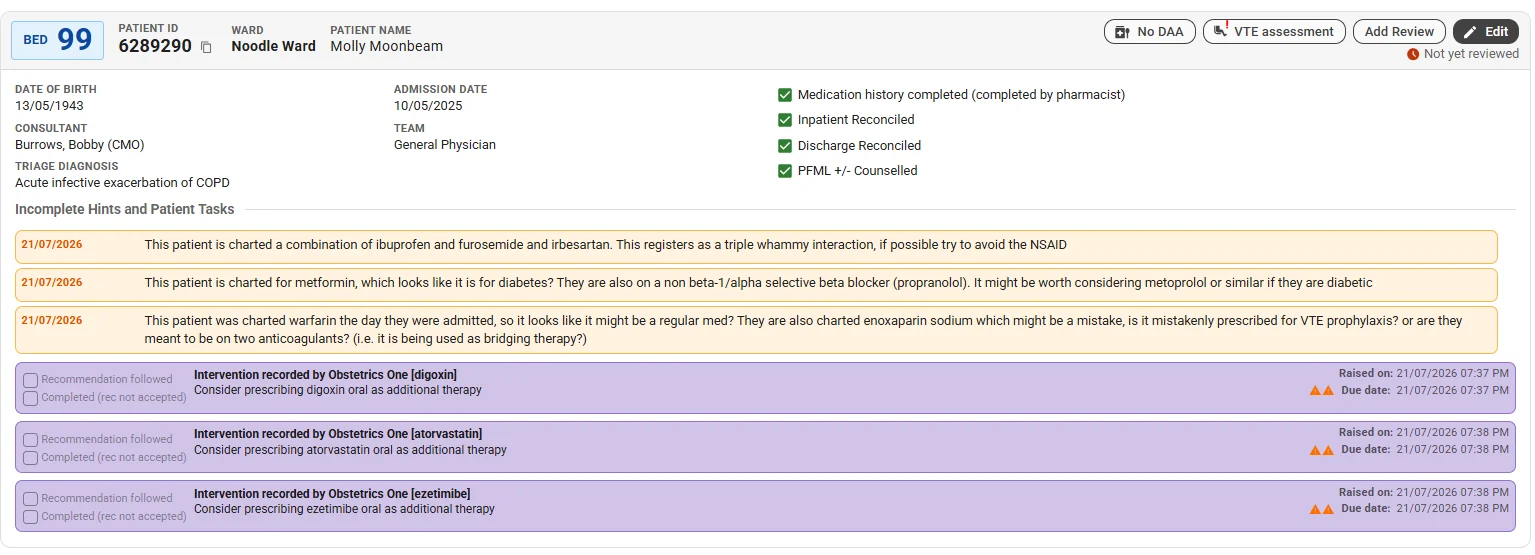
One medication history drives review, follow-up tasks and the patient-friendly list at discharge.
The challenges
- Medication histories are taken at the bedside and transcribed at a workstation. Pharmacists sharing a ward risk duplicating or overwriting each other's work, and an omission from the discharge list follows the patient home.
- A medication management plan completed at another hospital is often lost when the patient transfers, so the history starts again from scratch.
- Senior pharmacists hold extensive knowledge of how to identify and manage patient issues, but cannot devote their time to training every new and locum pharmacist. They need a way to hand that knowledge down.
- As the patient moves through the hospital, there is no pharmacy-driven handover of part-finished histories, reconciliation and possible interventions, and the patient-friendly medication list is left to a busy discharge.
Support across the admission
01 · PRIORITISATION
Review the highest-risk patients first
The pharmacy ward list ranks patients by the hints your service enables, filtered to the current admission, with earlier recommendations in view. Hints continuously screen the record for medication-related risk.
- A shared library of thousands of hints, enabled by your service
- Clear distinction between "no issues found" and "check not run"
- Rate each hint with a thumbs up or down at the bedside, and ratings refine the rules
- Senior pharmacists build local rules on the hint builder canvas, or adopt rules from neighbouring departments, so their experience reaches new and locum pharmacists
02 · MEDICATION HISTORY
Mobile scribing and medication photos, beside the full plan
Pharmacist scribing on the mobile app supports the ward round on a mobile device while the full medication management plan remains open at the workstation. Dictate the medication interview or photograph the patient's medicines and review a structured list, or start from a previous plan or one shared by a benchmarking partner service, so every source lands in one reconciled record.
- Dictate the interview or photograph the patient's medicines on the mobile app
- Entries captured offline are queued and synchronised when back in range
- Concurrent editing by multiple pharmacists on the same ward
- Admission and discharge reconciliation within the same record
03 · INTERVENTIONS AND FOLLOW-UP
Interventions become follow-up tasks
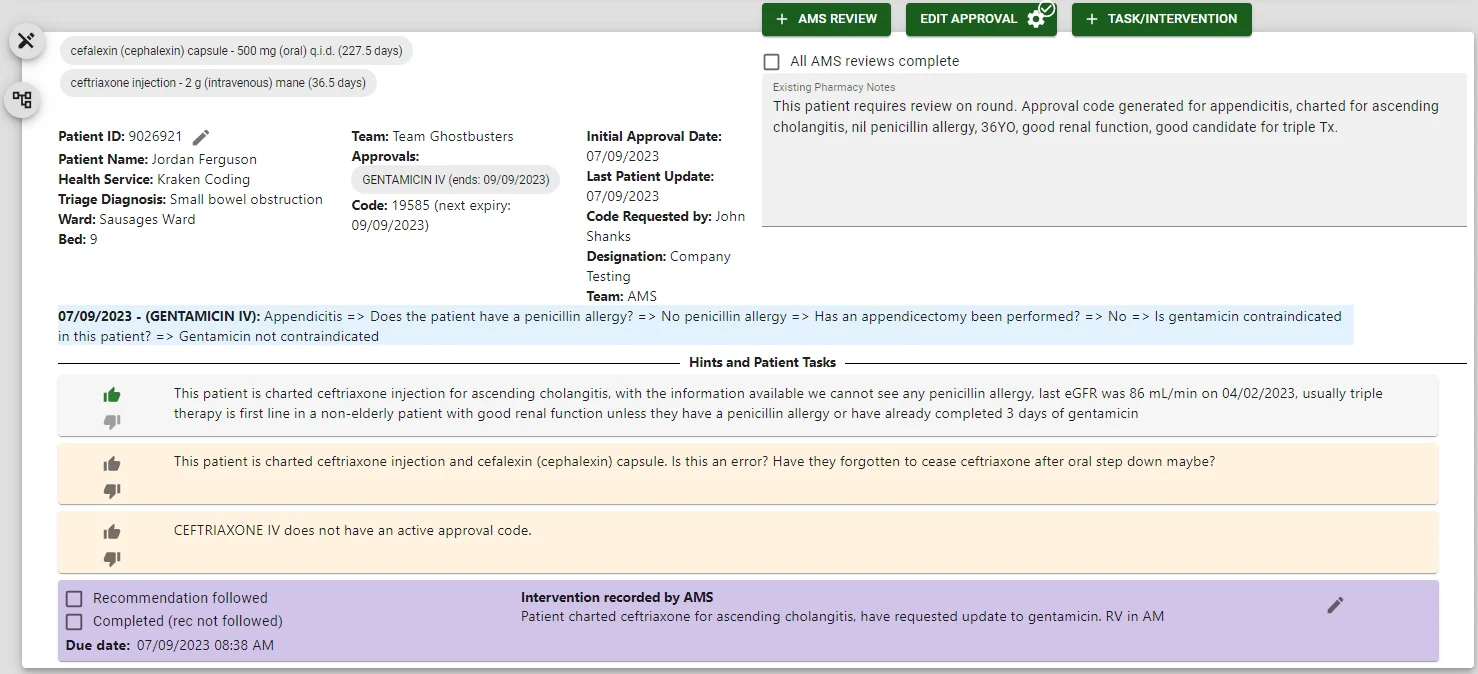
Structured, risk-banded interventions become planned follow-up tasks, handed over between shifts and wards, so the next pharmacist picks up a part-finished history, reconciliation or intervention where the last one left off, as the patient moves through the hospital.
- Follow-up tasks carry the intervention's risk band between shifts and wards
- Interventions and tasks visible to the whole team
- Every intervention reported on the pharmacy dashboards
04 · DISCHARGE
Patient-friendly medication lists at discharge
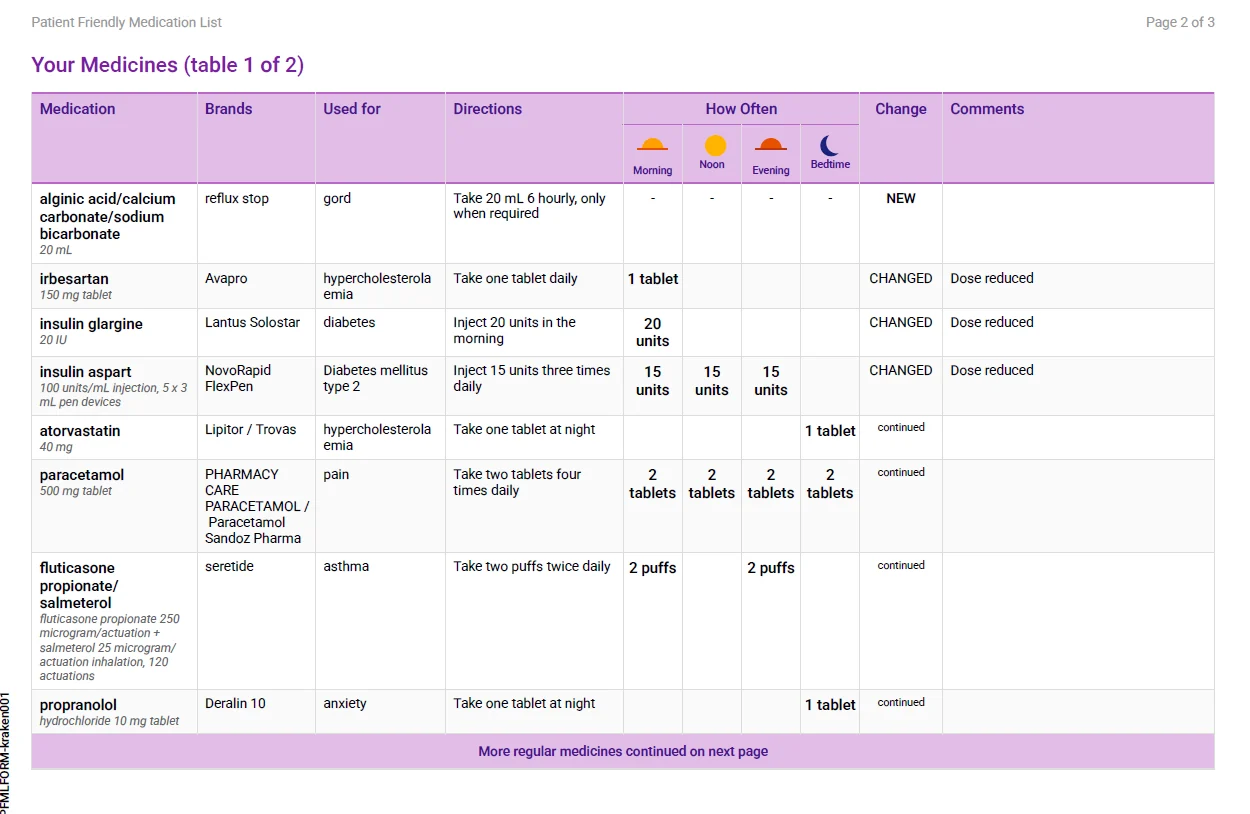
Discharge reconciliation generates the patient-friendly medication list from the same record, with no retyping during a busy discharge. It shows each medicine, its purpose, timing and any changes, with the most important medicines first. Alerts flag medicines omitted from the discharge list, and lists print clearly in black and white.
- Printable medication chart for transfer to residential aged care
- Medication management plans shared with the next hospital when it is a benchmarking partner service
- Developed with pharmacists across multiple health services
Dosing and medication safety tools
Vancomycin AUC dosing
Bayesian AUC dosing from a single level, validated against two patient cohort reference sets, synthetic data and clinical staff feedback, and undergoing TGA Class IIb conformity assessment.
Renal function alerts
Alerts when creatinine changes against currently charted medicines.
Aminoglycoside dosing
Dosing and duration checks for gentamicin and other aminoglycosides.
Allergy cross-reactivity
Cross-reactivity checks between documented allergies and charted medicines.
Formulary at the point of care
Formulary status, restrictions, and Product Information and Consumer Medicine Information, with IPU requests from the same view.
Intervention handover
Structured, risk-banded interventions shared with the team and carried between shifts.
Hint feedback
Clinicians rate each hint with a thumbs up or down, informing which hints remain enabled and how rules are refined.
Patient risk score
A risk score that updates as the record develops, bringing the highest-risk patients to the top of the list.
2
patient cohort reference sets used to validate vancomycin AUC dosing
84%
of 2,214 hints rated useful by pharmacists in a 12-month local evaluation
48.1s
average time to complete a pathway
77
hospitals live across Australia and Canada
The hint figure comes from a 12-month virtual stewardship programme at Far West Local Health District that reviewed every patient on an antimicrobial, presented at the SHPA Medicines Management conference. It is a local audit, not an independent evaluation. RAPA, named in the poster, is the audit tool within Clinical Branches. Read the conference poster (PDF). Vancomycin AUC validation was presented at Medicines Management 2025. Read the validation poster (PDF).
Get started
The vancomycin AUC calculator is included on every plan. If your department uses Clinical Branches, your Director of Pharmacy can enable the pharmacy ward list.
Explore other roles