
For opioid stewardship teams
Opioid stewardship
supported by data.
Opioid use dashboards aligned with the national acute pain clinical care standard, and automated hints that identify at-risk patients.Opioid use dashboards and automated hints that identify at-risk patients.
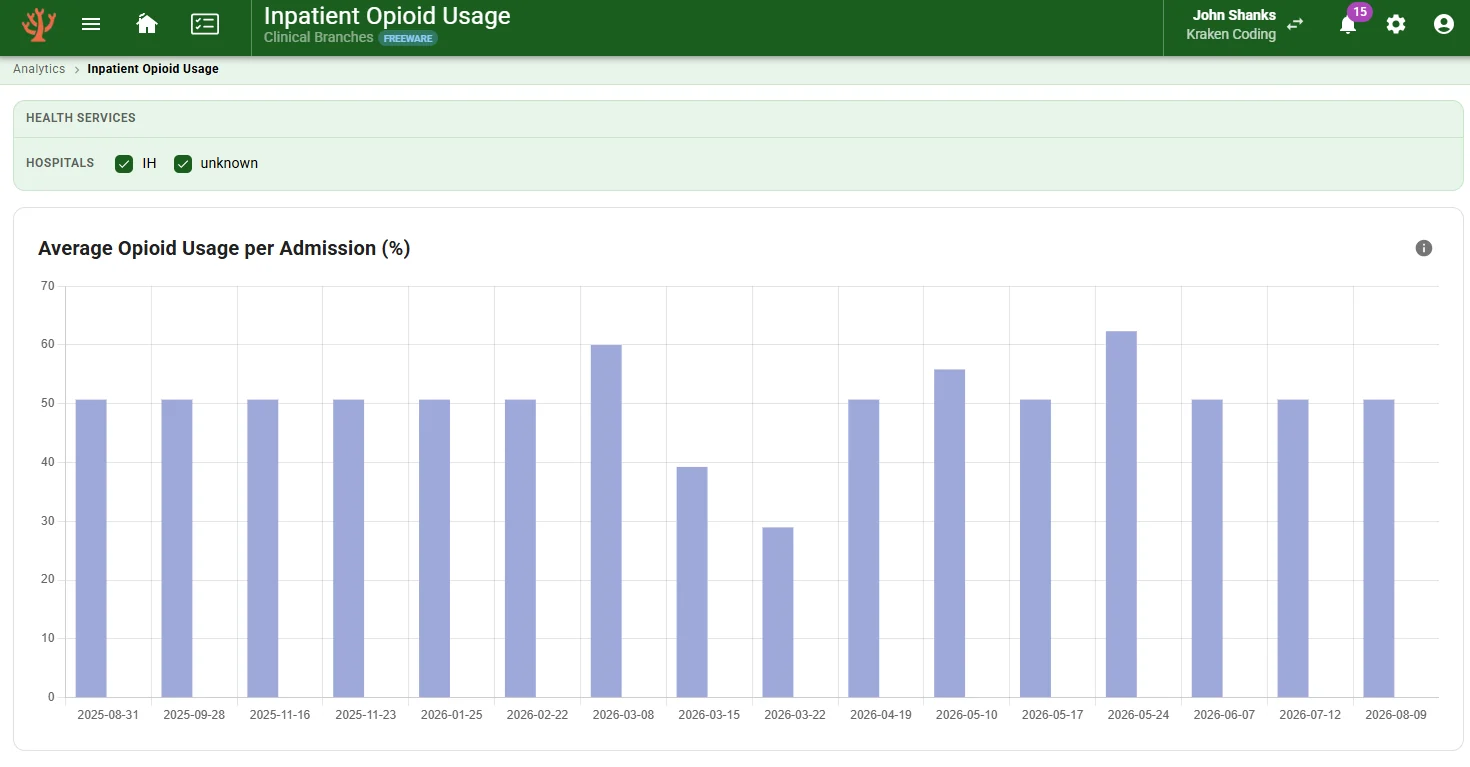
Each patient record ranks the stewardship list and reveals variation in opioid practice.
The challenges
- Opioids are among the most commonly prescribed high-risk medicines, reported against the Opioid Analgesic Stewardship in Acute Pain Clinical Care Standard and NSQHS Action 4.15, and stewardship teams must choose between reviewing only the highest-risk combinations and reviewing every patient on an opioid.Opioids are among the most commonly prescribed high-risk medicines, and stewardship teams must choose between reviewing only the highest-risk combinations and reviewing every patient on an opioid.
- Telling appropriate from inappropriate opioid use, from dose and duration to laxative cover and co-prescribing, is difficult from written notes or inconsistent EMR data, so evidence often relies on manual audit.
- Education fixes a recurring issue, only for the next rotation of staff to repeat the same error.
- Teams have limited prescribing confidence. An analgesic regimen started in the emergency department or recovery is often continued through admission and supplied at discharge without review, because busy teams do not know which regimen to use.
- Review happens after the opioid is charted. No tool improves opioid prescribing before the first dose.
- Without laborious audits, there is no way to see which wards, teams or entry points contribute to inappropriate opioid prescribing.
Capabilities for opioid stewardship
Point-of-care pathways, automated patient screening and reporting for your stewardship committee.
01 · REPORTING
Monitor opioid use across every ward
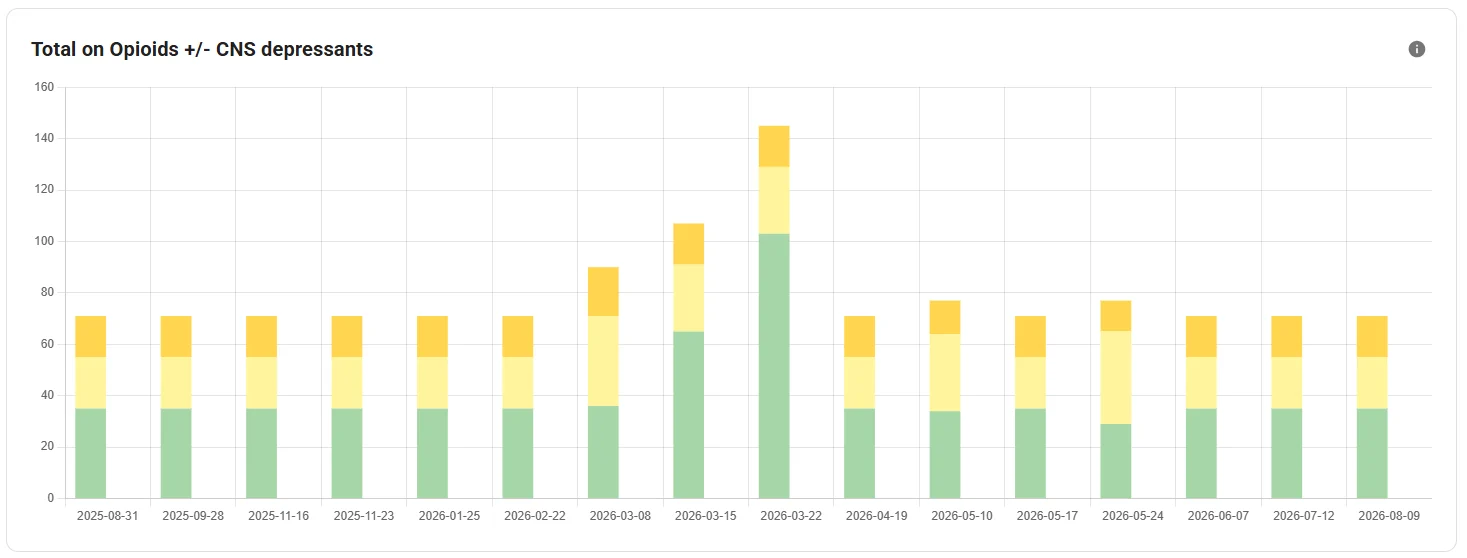
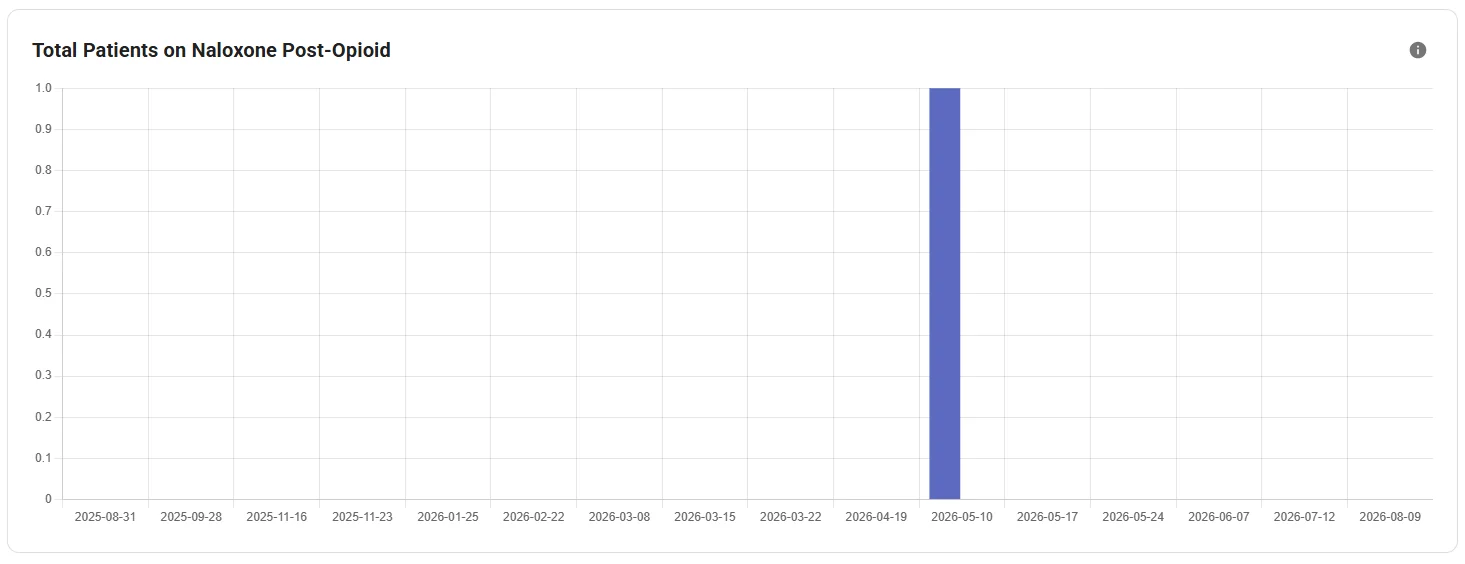
The opioid dashboard reports oral morphine equivalents per admission, agent mix, co-prescribing with CNS depressants, and naloxone administration following an opioid. For Cerner sites, clinical care standard indicators are available through Discern reporting, covering 10 of the standard's 15 indicators.For Cerner sites, indicators are available through Discern reporting.
- Weekly trends by hospital and ward
- Naloxone administration following opioids, as an indicator of over-sedation
- Variation by ward, to target education and deeper review
- Opt-in benchmarking with peer services
02 · PATIENT SCREENING
Identify at-risk patients automatically
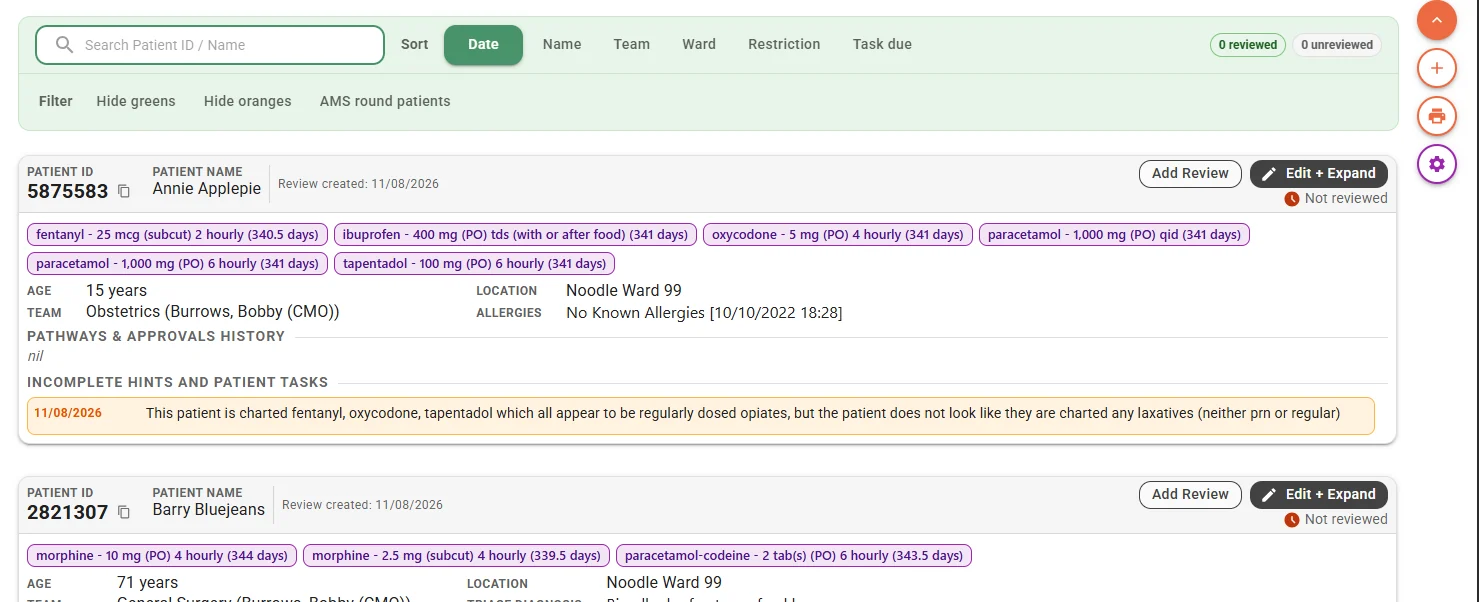
Opioid hints appear on the stewardship list your pharmacists already use. Your team subscribes to the hints its workflow needs from a shared library of thousands, and bedside ratings refine each hint over time, picking up combinations that are difficult to detect manually. Your senior pharmacists can build their own rules on the hint builder canvas or adopt rules from other services. Examples from the library include:
- Regular opioids without a charted laxative
- Cumulative daily dose across combination products, such as paracetamol with codeine
- Transdermal fentanyl with another opioid, and opioids with gabapentinoids, benzodiazepines or other CNS depressants
- Tramadol with serotonergic antidepressants, and PRN daily maximums carried with the order
03 · CONTINUOUS AUDIT
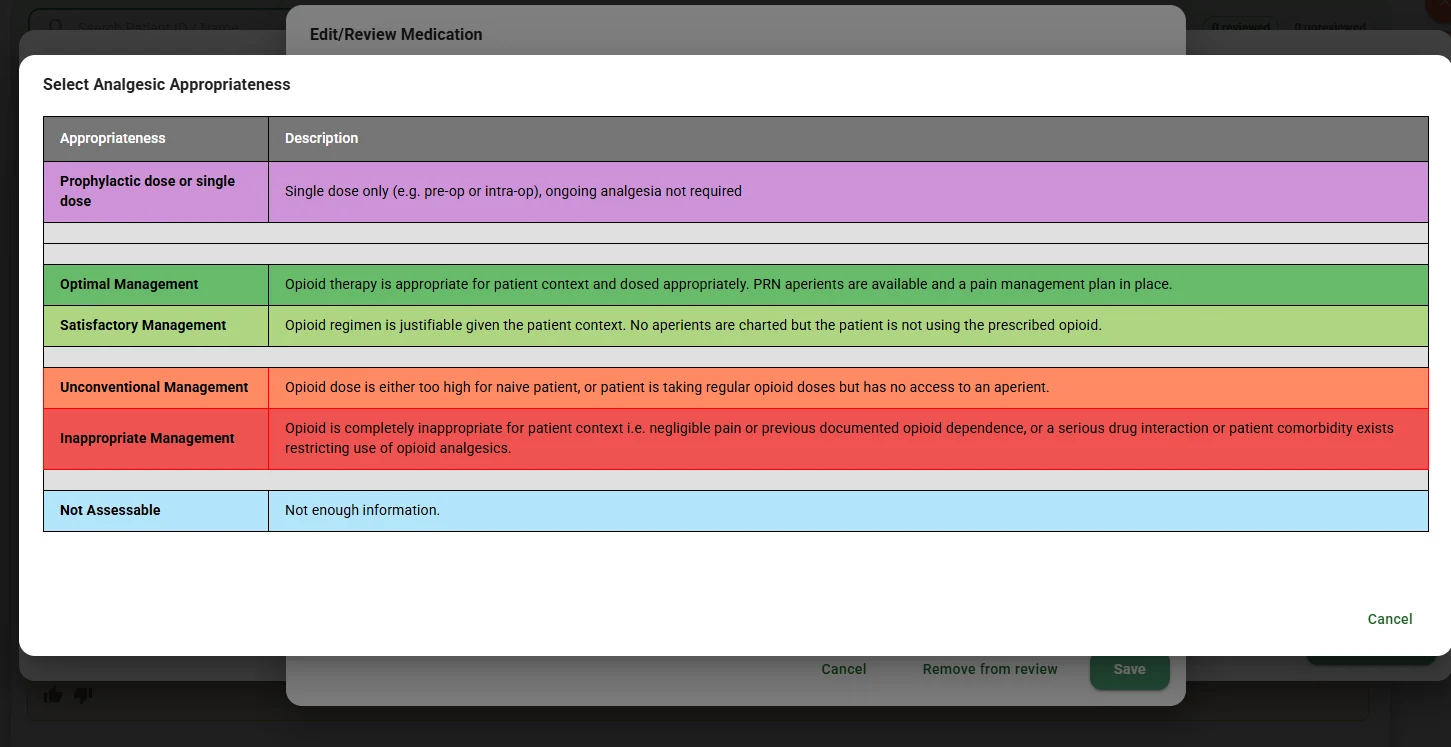
Integrated analgesic appropriateness audit
Record analgesic appropriateness during review, from prophylactic or single dose through optimal, satisfactory, unconventional and inappropriate management. Results are reported alongside the rest of your stewardship program.
04 · POINT-OF-CARE GUIDANCE
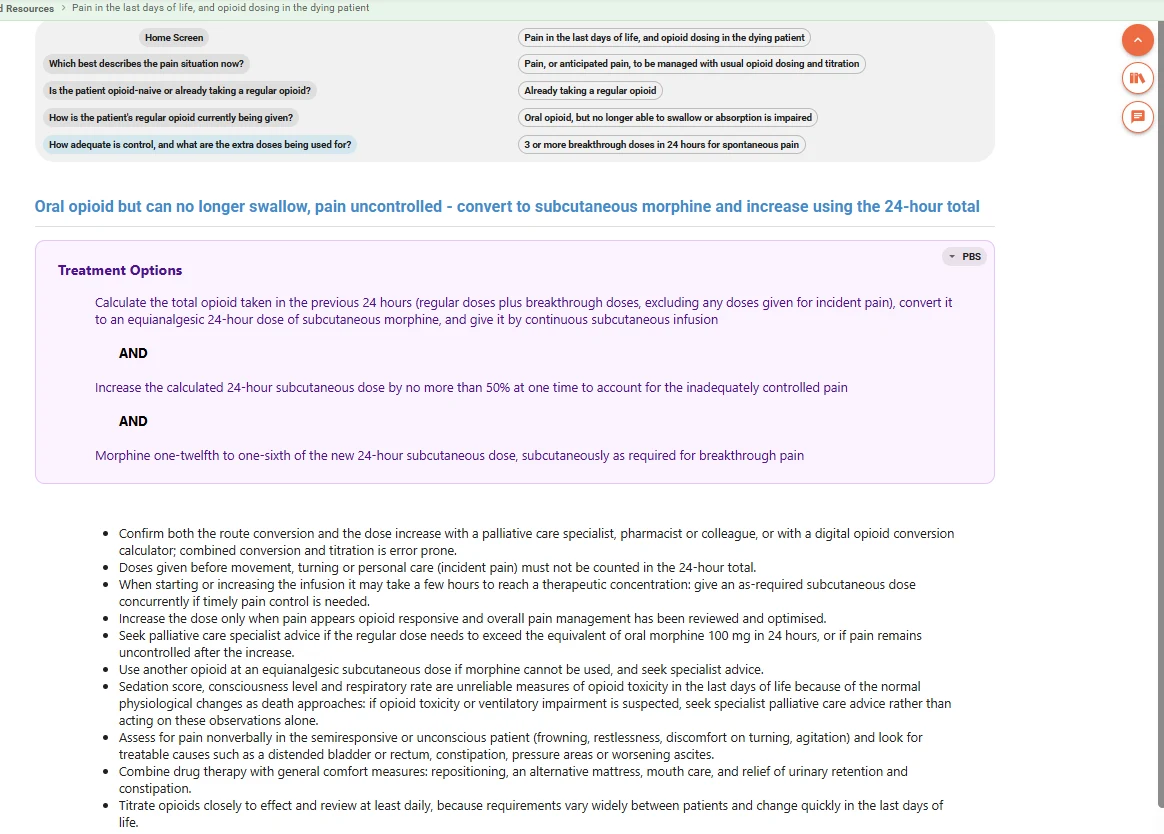
Pain management pathways
Pain management pathways, from severe acute pain, opioid titration and opioid-induced ventilatory impairment to opioid conversion and pain in the last days of life, guide prescribers at the point of care, and your service can build its own from local procedures. Stewardship committees review each pathway through the shared review panel.
20.8 pts
improvement in antimicrobial prescribing appropriateness, using the same pathway and hint model
21.8 pts
improvement in antimicrobial guideline compliance where adopted
48.1s
average time to complete a pathway
77
hospitals live across Australia and Canada
These results were measured for antimicrobials, not opioids. Joint evaluation of the platform by the WA Country Health Service (WACHS) and the University of Technology Sydney (UTS), funded by the Digital Health Cooperative Research Centre (DHCRC-0248). Prescribing was compared before and after implementation in a balanced sample of three adopter and five non-adopter hospitals, and the estimates describe an effect observed where the platform was adopted. WACHS deploys the platform as AMPS. Read the evaluation snapshot (PDF).
Implementation and support
A managed service with implementation, upgrades and support included.
Browser-based deployment
Runs in the browser on managed devices, with native iOS and Android apps. Single sign-on with Microsoft Entra ID is in production at multiple health services.
Live in two to six months
Environment, configuration and single sign-on in four to eight weeks, local content review alongside, then onboarding in two to four weeks per site group.
Upgrades and support included
Maintenance, security patching, releases and upgrades are included in the licence. Releases are zero-downtime with seven days notice, and support is delivered directly by the Clinical Branches team.
Predictable per-bed licensing
No per-user, per-transaction or per-query charges, so costs stay predictable as adoption grows.
Security and shared responsibilities Device information Plans and pricing
Pilot opioid stewardship with your committee
Begin with dashboards, hints and pain management pathways on your existing data. A daily report upload supports an initial pilot, with EMR integration to follow.
Explore other roles